Bhagavad Gita 3.27 — You Don’t Lack Knowledge. You Lack Intent
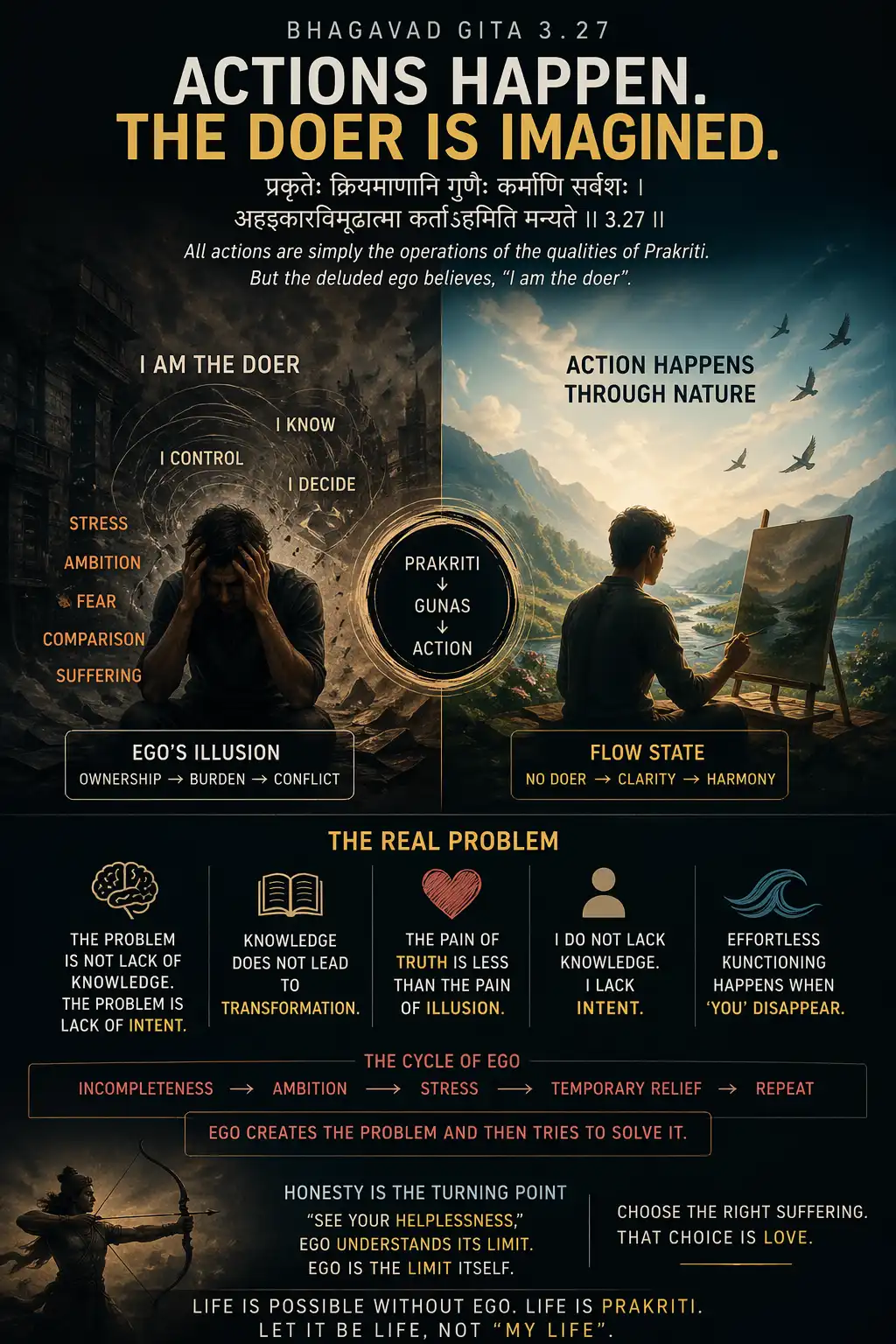
प्रकृतेः क्रियमाणानि गुणैः कर्माणि सर्वशः ।
अहङ्कारविमूढात्मा कर्ताऽहमिति मन्यते॥3.27॥Translation:
All actions are simply the operations (movement) of the qualities of Prakriti. But the deluded ego believes, “I am the doer”.
The Structure of Doership and the Illusion of Control
Prakriti (Nature) → Gunas (Forces) → Action (Karma)
                           ↓
                     Identification
                           ↓
                          Ego
                           ↓
                    “I am the doer”
                           ↓
                   Psychological Burden
The assertion that “all actions are carried out by the qualities of Prakriti” is not a mystical proclamation but a structural observation about existence. Movement happens. Processes unfold. Thoughts arise, decisions appear, bodies act. These are not isolated personal productions but expressions of a vast interdependent field—[[प्रकृति|Prakriti]], the totality of nature operating through its inherent tendencies.
Yet alongside this seamless functioning arises a secondary layer: the claim of ownership. The organism does not merely act; it begins to assert, “I am acting.” This assertion is not part of the action itself. It is an overlay. It is the emergence of [[अहंकार|ego]]—a psychological construct that appropriates what it does not initiate.
The verse points precisely to this distortion: actions happen through the gunas, but the deluded self claims authorship.
This claim extends further. The ego does not merely say, “I act.” It says:
- I know
- I control
- I decide
This triad—knower, controller, doer—forms the central illusion of individuality.
The critical insight is not that action stops without ego. Action continues. What disappears is the unnecessary psychological weight of authorship.
Experience Without Ego: Glimpses of Effortless Functioning
Action → Absorption → Dissolution of Self-reference → Excellence
Direct observation of lived experience reveals something striking. The moments considered most fulfilling are precisely those in which the sense of “I” fades.
Consider three ordinary but revealing situations:
- During intense sport, when attention is total and self-consciousness vanishes
- While engaging deeply with music, art, or cinema, where the observer dissolves into the experience
- In states of creative flow, where action seems to happen without deliberate effort
In each of these, there is action without the burden of authorship. There is precision without self-reference. These are not mystical states; they are empirically accessible.
And significantly, these are also moments of peak performance.
This leads to a structural recognition:
| Condition | Presence of Ego | Quality of Action |
|---|---|---|
| Self-conscious effort | High | Fragmented |
| Flow state | Minimal | Integrated |
| Deep absorption | Absent | Optimal |
The disappearance of ego is not a loss. It is a functional optimization.
This observation challenges a deeply held assumption: that ego is necessary for effective action. In reality, ego interferes. It divides attention. It introduces friction.
The best action occurs when the actor is absent.
The Ego’s Refusal: Knowledge Without Transformation
Fact → Recognition → Resistance → Continuation of Pattern
In the contemporary world, many aspects of human experience have been reduced to measurable phenomena. Stress, jealousy, anger—these are increasingly understood as biochemical processes. They can be quantified, studied, and explained.
In principle, this should lead to clarity.
Yet something peculiar persists: knowledge does not lead to transformation.
The ego can see the facts. It can understand:
- Stress is harmful
- Anger disrupts
- Jealousy corrodes
And still, it continues unchanged.
This reveals a crucial distinction:
The problem is not lack of knowledge.
The problem is lack of intent.
The ego resists dissolution, even when its own suffering is evident. It prefers continuity over truth. It clings to its structure, even at the cost of discomfort.
This is why mere intellectual clarity is insufficient. Something deeper is required—an inner alignment that allows truth to penetrate beyond conceptual understanding.
That alignment is often referred to as [[honesty]] or [[प्रेम|love]].
Not as emotion, but as a willingness to see without distortion.
The Self-Creating Cycle of Egoic Suffering
Ego → Sense of Incompleteness → Ambition → Stress
     → Temporary Relief → Return to Same Structure → Repetition
The ego sustains itself through a cyclical mechanism.
It begins with a fundamental assertion: “I am incomplete.”
From this arises ambition—the drive to become, to achieve, to accumulate.
Ambition generates effort, comparison, and inevitably, stress.
Having created stress, the ego then seeks relief. It turns to temporary escapes:
- Entertainment
- Leisure activities
- Controlled experiences of beauty
These provide momentary respite. But they do not dissolve the underlying structure.
Thus, after the weekend relief, the same stress resumes.
The cycle continues.
This is not accidental. It is structural. The ego requires problems to sustain its identity. Without tension, it has no narrative. Without narrative, it dissolves.
Therefore:
The ego creates the very disturbances it later claims to suffer from.
It is both the generator and the complainant.
The Avoidance of Depth: Horizontal Movement vs Vertical Insight
Discomfort → Avoidance → Diversification → Surface Engagement
                                      ↓
                                 No Transformation
Another subtle movement of the ego is its resistance to depth.
When confronted with an opportunity for genuine inquiry—one that might challenge its structure—the ego often diverts attention.
Instead of going deep into one line of understanding, it moves horizontally:
- Sampling different teachings
- Jumping between philosophies
- Accumulating intellectual variety
This creates the illusion of progress.
But structurally, nothing changes.
Depth requires confrontation. It demands that one remain with a question until it dissolves the questioner.
Horizontal movement avoids this dissolution.
It is a strategy of preservation.
Love, Pain, and the Necessity of Inner Alignment
Truth → Discomfort → Resistance
      ↓
   Acceptance → Dissolution → Freedom
The movement toward truth is not comfortable.
It disrupts established patterns. It exposes illusions. It challenges identity.
This is why it is often described as painful.
But this pain must be understood correctly. It is not the pain of damage. It is the pain of dismantling.
And crucially:
The pain of truth is less than the pain of illusion.
This leads to a fundamental principle:
“The alternative is much worse.”
Dishonesty may feel easier in the moment. Avoidance may provide temporary comfort. But the long-term consequence is deeper suffering.
Thus, the choice is not between pain and no pain. It is between:
- Conscious discomfort that leads to clarity
- Unconscious suffering that perpetuates confusion
This is where [[प्रेम|love]] becomes central—not as sentiment, but as commitment to what is true, regardless of immediate discomfort.
Life Without Ego: Possibility and Misconception
Life (Prakriti) → Functioning → No Ownership → Harmony
          vs
Ego → Ownership → Conflict → Fragmentation
A common assumption is that ego is necessary for life. That without ego, functioning would cease.
But this assumption does not hold under examination.
Life precedes ego. Biological processes, perception, response—all occur without the need for psychological ownership.
The question then arises:
Why must life be “my life”?
Why cannot it simply be life?
The insertion of “my” introduces division. It creates separation between the individual and the whole.
This separation leads to conflict.
Without ego, there is still action, perception, intelligence. What disappears is the unnecessary layer of self-reference.
Thus:
- Life without ego is possible
- Life with minimal ego is observable
- Life dominated by ego is conflicted
The issue is not survival. It is psychological burden.
The Role of Systems: Concealment of Consequences
Action → Consequence → Systemic Buffer → Delayed Realization
Modern civilization has developed systems that buffer individuals from the immediate consequences of their actions.
These systems provide stability, comfort, and protection.
But they also have a side effect: they obscure reality.
For example, environmental degradation continues, yet its consequences are often delayed or distributed. This allows destructive patterns to persist without immediate correction.
Similarly, psychological suffering is often masked by distractions, conveniences, and social structures.
Without these buffers, the consequences of ego-driven living would be more immediately visible—and perhaps intolerable.
Thus, systems both support and conceal.
They protect, but they also enable avoidance.
Intent vs Method: The Core Distinction
Knowledge → Method → Application
        vs
Intent → Direction → Transformation
A critical distinction emerges between method and intent.
Methods are abundant. Techniques, practices, disciplines—these can be learned, refined, and applied.
But methods do not guarantee transformation.
Because transformation depends on intent.
One may know what is right and still not act accordingly. This is a common human experience.
The gap between knowledge and action is not due to lack of information. It is due to lack of alignment.
Thus, the honest recognition becomes necessary:
“I do not lack knowledge.
I lack intent.”
This recognition is not defeatist. It is precise.
Only when the problem is correctly identified can it be addressed.
Ego as Limitation and the Beginning of Clarity
Observation → Helplessness → Recognition of Limits → Quieting of Ego
The ego thrives on the illusion of control. It sustains itself through the belief that it can manage, direct, and resolve.
But sustained observation reveals its limitations.
Despite effort, patterns persist. Despite knowledge, behavior repeats.
This leads to a moment of clarity: the recognition of helplessness.
This is not psychological collapse. It is structural insight.
It reveals that the ego is not the master it claims to be.
In fact:
The ego is itself the limitation.
It is not that the ego has limits. It is that ego is the limit.
This recognition has a paradoxical effect. It begins to quiet the ego.
Because the illusion of control weakens.
And in that quieting, a different quality of intelligence becomes possible—one not rooted in self-reference.
Integration: From Doership to Clarity
Prakriti → Action → No Doer
         ↓
   Misidentification
         ↓
        Ego
         ↓
   “I am the doer”
         ↓
   Conflict / Stress
         ↓
   Observation / Honesty
         ↓
   Dissolution of Claim
         ↓
   Effortless Functioning
The central confusion lies in the misidentification of action with authorship.
Action belongs to Prakriti. It is the natural movement of life.
The ego appropriates this movement and claims ownership.
This claim generates burden—psychological, emotional, and existential.
Through observation, this claim can be seen.
Through honesty, it can be questioned.
Through sustained clarity, it can dissolve.
What remains is not inaction, but action without burden.
Not passivity, but precision without self-consciousness.
Not emptiness, but freedom from unnecessary identification.
The verse does not ask for belief. It points to a structure.
And once seen, the structure does not require enforcement. It naturally reorganizes perception.
The doer was never real.
Only the doing was.