Shrimad Bhagavad Gita 3.32 — Why Krishna Says the Deluded Are Already Lost
ये त्वेतदभ्यसूत्वेतदभ्यसूयन्तो नानुतिष्ठन्ति मे मतम्विमूढांस्तान्विद्धि नष्टानचेतसः।।3.32।।
Those who are deluded about all knowledge, devoid of consciousness, invested in cavil, and who do not honour my teachings: do not think that their future will be ruined or that they will one day perish at the hands of Time. They are already destroyed today.
Krishna’s words are often misunderstood as a warning about the future. It is tempting to hear them as a prediction: if one refuses wisdom today, suffering will arrive tomorrow; if one rejects the truth now, destruction awaits in another life or at some distant point in time. Yet that is not the force of the verse. Krishna is not announcing a future punishment. He is revealing a present fact.
The person who cannot receive the truth is not walking toward destruction. He is already living it.
This is a profoundly different way of understanding spiritual failure. Destruction is not merely the consequence of wrong action. It is the condition from which wrong action arises. The inability to recognize truth is itself evidence that the inner order necessary for freedom has already collapsed.
False Identification
        ↓
Ego
        ↓
Distorted Perception
        ↓
Wrong Action
        ↓
Further Bondage
The ego imagines that it remains free until consequences eventually arrive. It lives on borrowed time, forever promising that tomorrow will be different. It overeats today while promising discipline tomorrow. It indulges greed today while planning generosity in the future. It sacrifices integrity today while hoping to recover dignity later. Every postponement strengthens the illusion that freedom still exists.
But the postponement itself is proof of slavery.
The ego says, “I will deal with it later,” because it assumes there will always be a later in which the same self can suddenly become wise. Krishna dismantles this comforting illusion. The one making that promise is already incapable of fulfilling it, because the very structure that postpones transformation is the structure that prevents transformation.
The consequence has already arrived. It appears as the actor.
A thief does not become a thief after stealing. The theft merely expresses what already exists inwardly. Likewise, ego does not occasionally perform selfish acts; ego itself is the movement of appropriation. It does not imitate fear. It is organized around fear. It does not sometimes deceive itself. Self-deception is its native language.
This shifts the entire discussion from morality to psychology. Spiritual teaching is not primarily concerned with isolated behaviors. It is concerned with the consciousness from which behaviors arise. If the root remains untouched, pruning the branches changes little.
The Actor Is the Consequence
Ordinarily we imagine a sequence: first there is action, then there is consequence. The Bhagavad Gītā quietly reverses this order.
The consequence exists before the action because the actor is already shaped by ignorance. Every action merely reveals the condition of the one acting.
A jealous person does not occasionally become jealous. Jealousy has become the atmosphere through which every relationship is interpreted. Likewise, greed does not merely produce harmful decisions; greed is already the impoverishment of consciousness. Lust is not simply an appetite directed toward objects. It is an inability to encounter another without converting them into an instrument of one’s own psychological need.
The ego longs for freedom, love, peace, and fulfillment. It speaks sincerely about these aspirations. Yet sincerity alone changes nothing.
The contradiction lies elsewhere.
The ego values freedom, but it also values psychological security. It values love, but it values control just as much. It values truth, but only so long as truth does not threaten the image it has constructed of itself. These competing priorities ensure that its highest values remain permanently unrealized.
Love
      ↘
       Ego
      ↗
Security, Status, Control

Result:
Love is admired,
but never chosen completely.
The tragedy of ego is therefore not hypocrisy in the ordinary sense. Its longing for love is genuine. What prevents fulfillment is that love never occupies the highest place in its hierarchy of values. Whenever truth demands the death of illusion, illusion is protected instead.
Thus the prison is not imposed from outside. The prisoner builds the prison every day and mistakes the construction for self-preservation.
The Ignorance Hidden Behind Knowledge
Krishna describes such people as sarva-jñāna-vimūḍha—deluded regarding all knowledge.
This does not describe intellectual deficiency.
The ego may possess extraordinary information. It may understand politics, economics, psychology, technology, literature, philosophy, and science. It may speak eloquently and accumulate impressive credentials. None of this guarantees self-knowledge.
Indeed, knowledge often becomes nourishment for the ego.
Every new fact strengthens the conviction that “I know.” Every achievement reinforces psychological identity. Learning becomes another possession.
The deeper ignorance is not the absence of information. It is the assumption that the knower has already been understood.
Human beings confidently declare:
“I know who I am.”
“This is my name.”
“This is my family.”
“This is my profession.”
“This is my success.”
“This is my identity.”
These statements appear factual, yet psychologically they conceal profound ignorance. They describe social roles, memories, and relationships while leaving untouched the fundamental question of the one who experiences them.
Whenever ego says, “I know myself,” it converts the living mystery of consciousness into another object of possession. Everything ego possesses eventually becomes imprisoned within its categories. Thus even the self becomes another concept to defend rather than a reality to discover.
There is an irony here. The areas of life that remain alive are often those we have not completely reduced to conclusions. The moment we become certain, inquiry ceases. Certainty is comforting, but it is rarely transformative.
The ego destroys not because it hates life but because it insists on replacing reality with definitions.
Devoid of Consciousness
Krishna’s second description is equally severe: achetasaḥ—devoid of consciousness.
This should not be mistaken for physical unconsciousness. Such people think, speak, plan, and accomplish many things. They appear intelligent and active.
Yet inwardly their lives unfold almost entirely through conditioning.
Experience produces memory.
Memory produces reaction.
Reaction masquerades as choice.
Experience
      ↓
Memory
      ↓
Conditioning
      ↓
Reaction mistaken for Choice
This is the psychological machinery of ego.
When consciousness is absent, life becomes mechanical. The individual believes himself to be making independent decisions while merely repeating inherited patterns of fear, ambition, comparison, and desire.
Freedom cannot emerge from unconscious repetition.
To be conscious is not merely to think about oneself. It is to observe the movement of thought before becoming identified with it. Without such observation, thinking becomes destiny.
The ego proudly proclaims autonomy while living as the servant of countless compulsions.
Why Ego Attacks the Teacher
Krishna’s third description is perhaps the most psychologically penetrating: abhyasūyantaḥ—those invested in cavil, fault-finding, and hostile criticism.
At first glance this appears to concern disagreement with scripture or teacher. But the criticism rarely originates from intellectual inquiry.
The ego does not truly oppose Krishna, Buddha, or any authentic teacher as historical individuals.
It opposes dissolution.
The teacher merely becomes the visible target because he embodies the possibility of the ego’s end.
If suffering disappears, the sufferer as a psychological identity also disappears. Ego senses this instinctively. Therefore it develops subtle strategies of resistance.
It criticizes the teacher’s personality instead of examining the teaching.
It dismisses scripture as outdated.
It asks for something “modern,” “practical,” or “relevant.”
It replaces self-knowledge with endless techniques for improving the existing self.
The argument appears intellectual, but its motive is existential.
The question is not whether Krishna belongs to an ancient civilization. The question is whether the truth he points toward threatens the identity that wishes to survive.
This is why cavil is spiritually dangerous.
There are many mistakes from which one can recover. One may misunderstand, become distracted, or even temporarily fall into ignorance. But persistent fault-finding directed toward the very possibility of liberation removes the medicine before healing can begin.
It resembles a patient who rejects every physician because accepting treatment would require admitting illness.
The refusal protects pride while destroying life.
Forgetting What Matters
A revealing feature of human psychology is selective memory.
A person diagnosed with a serious disease rarely forgets the diagnosis. Even dreams become colored by it because the mind has judged it to be vitally important.
Yet many sincerely complain that they repeatedly forget spiritual teachings.
The problem is not memory.
It is valuation.
We remember what we inwardly consider indispensable.
If the teachings of the Gita repeatedly disappear from awareness while trivial entertainments remain vividly remembered, the explanation is uncomfortable but simple: somewhere within, the preservation of ego has been valued above the transformation of consciousness.
The same mechanism appears in another common complaint.
“I go blank during spiritual discourse.”
But the same person does not go blank while shopping, watching a favorite sport, enjoying comedy, or pursuing sensual pleasure.
Attention faithfully follows desire.
When attention repeatedly abandons inquiry, the issue is rarely intellectual incapacity. It is unconscious resistance.
The ego has many methods of self-preservation. Distraction is one. Sleep is another. Endless postponement is perhaps the most respectable.
It whispers, “I am not ready.”
Yet this resembles saying, “I will visit the doctor once my illness disappears.”
Healing requires precisely the opposite. One approaches the physician because illness exists, not because it has already vanished.
The Silent Recognition
Not every genuine insight arrives through argument.
Sometimes one simply looks inward without immediately translating experience into thought. There is no dramatic revelation, no mystical spectacle, no emotional explosion.
There is only recognition.
One sees directly.
“I already knew.”
The truth was never entirely absent. It was merely overshadowed by endless psychological noise.
This wordless recognition differs fundamentally from intellectual agreement. Agreement belongs to concepts. Recognition belongs to awareness itself.
No amount of borrowed philosophy can replace such seeing.
Concepts may prepare the ground, but only direct observation dissolves illusion.
Waiting for Salvation
Human beings often imagine liberation as an event that will occur someday. They continue living mechanically while secretly expecting that circumstances, destiny, or divine intervention will eventually transform them.
It resembles the characters in [[Waiting for Godot — On Waiting as Self-Sabotage|Waiting for Godot]], endlessly expecting someone whose arrival never changes the structure of waiting itself.
Krishna overturns this fantasy.
The divine is not withholding itself.
Truth is already available.
The invitation has already been extended.
The question is whether one accepts it.
No teacher can impose liberation upon an unwilling mind. Grace may reach toward every individual, but consent cannot be replaced. A hand may always be extended; it must still be grasped.
Thus salvation is neither earned nor forced.
It is received.
The Ego That Must End
This does not require hostility toward life or the body.
A crucial distinction must be maintained.
| Physical Ego | Psychological Ego |
|---|---|
| Functional identity | Imagined identity |
| Necessary for practical living | Source of bondage |
| Coordinates action | Seeks permanence through illusion |
The body may retain its functional identity. Society requires names, professions, and responsibilities.
What becomes irrelevant is the psychological demand that these temporary roles define who one fundamentally is.
Freedom does not erase practical existence.
It erases false identification.
The Teacher’s Real Mission
An authentic teacher does not seek admiration.
Praise contributes nothing to truth.
Followers contribute nothing to freedom.
The teacher’s concern is not personal importance but transformation.
A mission cannot be fulfilled through admiration alone. It requires students willing to examine themselves with uncompromising honesty.
The greatest respect one can offer a teacher is therefore not devotion to personality but seriousness toward inquiry.
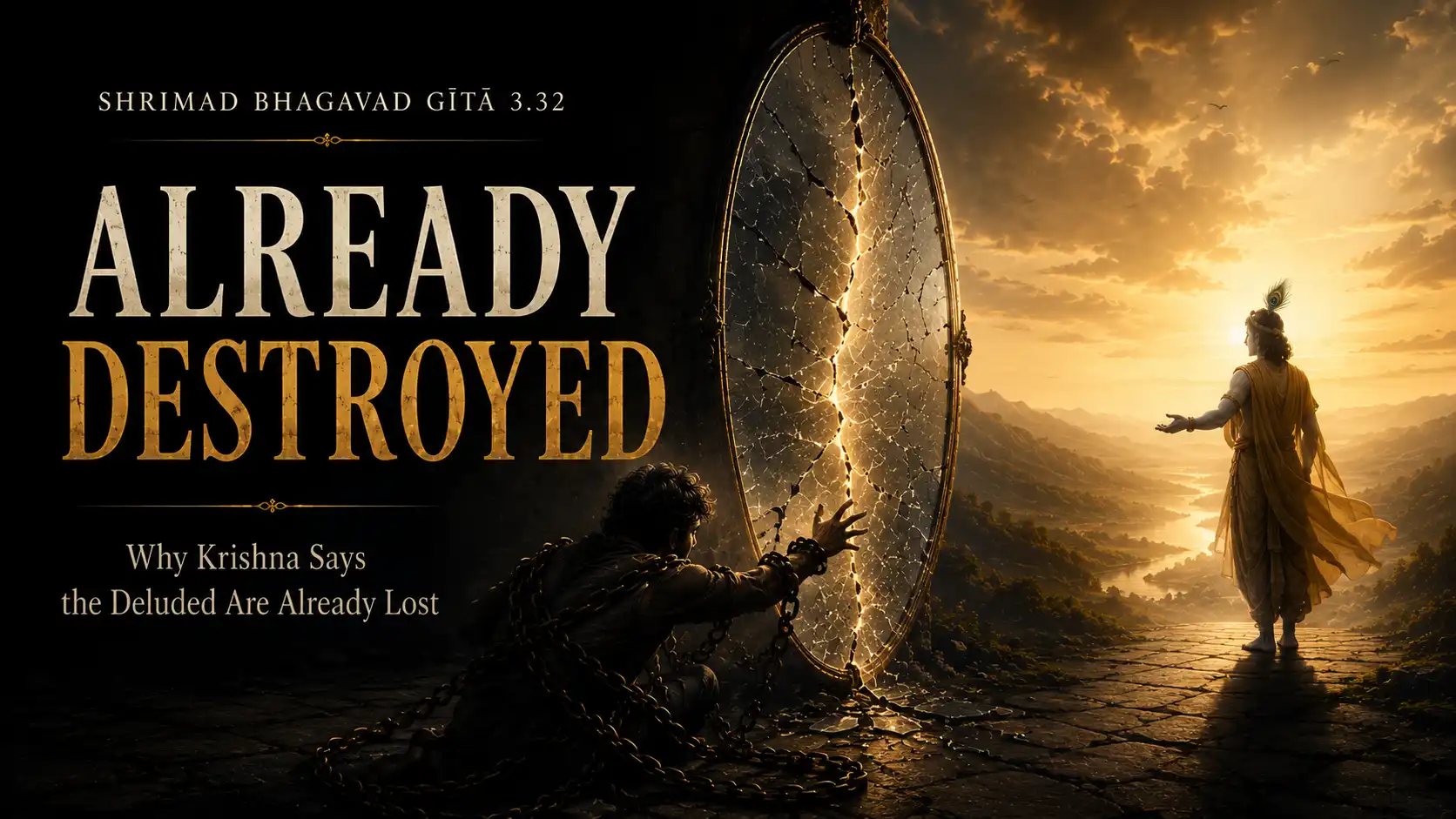
The teacher points toward a mirror.
Whether one looks into it remains one’s own responsibility.
Teacher
      ↓
Mirror
      ↓
Self-Observation
      ↓
Dissolution of False Identity
      ↓
Freedom
Krishna’s statement therefore contains neither condemnation nor threat. It is diagnosis. The ego believes it is protecting itself through postponement, criticism, distraction, certainty, and attachment to identity. Yet every one of these defenses deepens the very bondage from which it seeks escape.
To reject truth is not merely to miss an opportunity. It is to reveal the structure through which suffering continually recreates itself. The prison is maintained not by external forces but by the mind’s unwavering loyalty to its own illusion.
The invitation of the Gita is therefore astonishingly simple and uncompromising. Stop defending the prison. Stop mistaking inherited identities for yourself. Stop treating the medicine as the enemy because healing threatens the disease. The obstacle has never been the absence of truth; it has always been the ego’s investment in remaining what it already is.
When Krishna says that such people are “already destroyed,” he is not speaking from anger. He is describing the condition of a consciousness that has become alienated from its own possibility. The tragedy is not that liberation is unavailable. The tragedy is that the one who longs for freedom continually chooses everything except the transformation through which freedom becomes possible.
The verse thus becomes less a judgment upon humanity than an invitation to radical honesty. The decisive question is no longer whether one agrees with Krishna, but whether one is willing to see the subtle ways in which the ego protects itself against the very light that alone can dissolve it. Only in that seeing does the movement of destruction come to an end, and only there does genuine freedom cease to be an idea and become a living fact.